Choosing how to secure your premises affects safety, convenience and how easily you can manage who goes where. Traditional locks have protected buildings for centuries and still have their place. Electronic access control offers far more control and visibility. For many businesses looking at access control in Birmingham, the real question is where each option makes the most sense.
How traditional locks work
Mechanical locks use physical keys. They are simple, familiar and relatively inexpensive, and they do not need power or software. For a small business with one or two doors and a handful of trusted staff, a good-quality lock can be perfectly adequate.
The weaknesses appear as a business grows. Keys get lost, are not returned when people leave, or are copied without your knowledge. Each time that happens, the safe response is to change the lock and reissue keys, which costs money and time. It is also difficult to give people access to some rooms but not others without carrying a bunch of keys, and there is no record of who opened which door or when.
How access control works
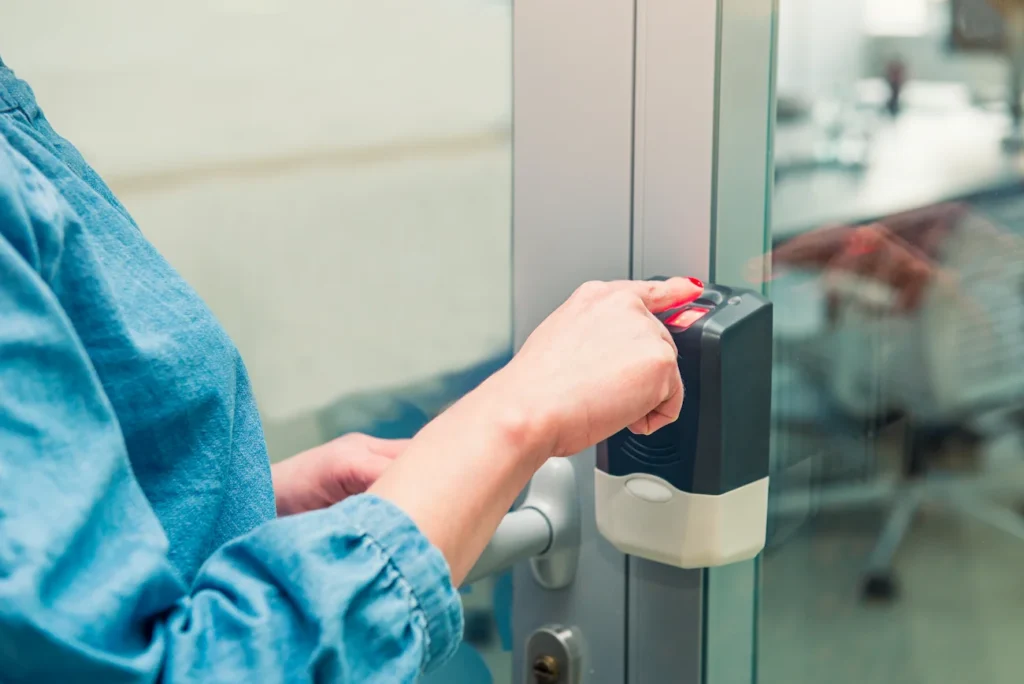
An access control system uses electronic readers to manage entry. Instead of a key, people use a card, fob, PIN code, smartphone or biometric reader. Each user is given permissions that set which doors they can open and, if needed, at what times.
Administrators can add or remove users instantly. If someone leaves, their access is cancelled in moments. Most systems also record entry activity, giving you a clear history of who went where.
The key differences
The biggest difference is control. A lock offers one level of access: you either have the key or you do not. Access control lets you set different permissions for different people, doors and times, and change them whenever you need to.
Visibility is the other major difference. Locks tell you nothing about who has been in. Access control gives you an audit trail that supports investigations, compliance and day-to-day security management.
Practical points to consider
- Power and fire safety
Electronic locks need power, so systems are designed to behave in a set way if the power fails. Fail-safe locks release when power is lost, which is usually required on escape routes and fire doors. Fail-secure locks stay locked, which can suit stockrooms or server rooms that are not on an escape route. A competent installer will design this around your building and its fire strategy.
- A middle ground
For some businesses, a restricted key system is a sensible step up from standard locks. Keys can only be copied with authorisation, which closes one of the biggest loopholes, although you still do not get the audit trail or instant changes of an electronic system.
- Combining both
Many premises use both. Access control on main entrances, office suites and sensitive rooms, with good mechanical locks on cupboards and low-risk doors, often gives the best balance of cost and security.
Which option fits your business?
Traditional locks remain a reasonable choice for small premises with few users and simple access needs. Access control becomes the better option when you have more staff, regular visitors or contractors, sensitive areas, multiple sites, or a need to know who entered and when.
A professional assessment of your premises will show which approach makes sense, how many doors need controlling and how a system would work with your existing security.
Access control from Spectra Fire and Security
If you are ready to move beyond traditional locks, contact Spectra Fire and Security. Our team will visit your property, recommend a system that suits your building and the way you work, and handle the installation and ongoing support.